Free To Use Review - The Safest Royalty-Free Music Platform for Content Creators
A Platform That Owns Every Track It Sells
Here is the first thing you need to understand about Free To Use, and honestly, it is the whole story: this is a royalty-free music service where the company holds 100% ownership of every single track in the catalog. Not licensing agreements with independent uploaders. Not "community" submissions. Complete, outright ownership of the recording and the composition.
Why does that matter? Because the most common way creators get burned is when a track they trusted suddenly gets claimed by someone else. Maybe the original producer decided to register it with YouTube's Content ID system. Maybe they pulled it and re-uploaded it under different terms. Maybe they simply changed their mind about giving it away free. Whatever the trigger, the video you published months ago suddenly gets hit with a copyright claim, and you are the one dealing with the fallout.
When the platform owns the music, none of that can happen. There is no third party with standing to claim your video, because the rights belong entirely to the platform. This is the fundamental safety guarantee that sets Free To Use apart.
Why "Royalty-Free" Confuses People
A lot of creators assume "royalty-free" means "no one owns this, use it however you want." That assumption is wrong, and it is the root of countless copyright headaches.
Let me be precise about the terminology, because getting this straight will save you real trouble.
Royalty-free is a payment model, not a rights statement. It means you do not pay a per-play royalty. The music is still copyrighted, someone still owns it, and your use is still governed by a license. If that license says "attribution required," and you skip the attribution, you have broken the terms even though the music was "free."
Free to download is also not a safety signal. A download button tells you nothing about who holds the rights, whether those rights might change, or who will come after your video if a dispute arises.
The point is simple: what protects you is not the download button, but the ownership behind it. A platform that owns its catalog can guarantee safety. A platform that merely hosts uploads is always one producer decision away from putting you in a copyright fight.
Taking a Walk Through the Library
I spent about an hour poking through the catalog for this review, because discovery experience matters when you are actually hunting for a track on deadline.
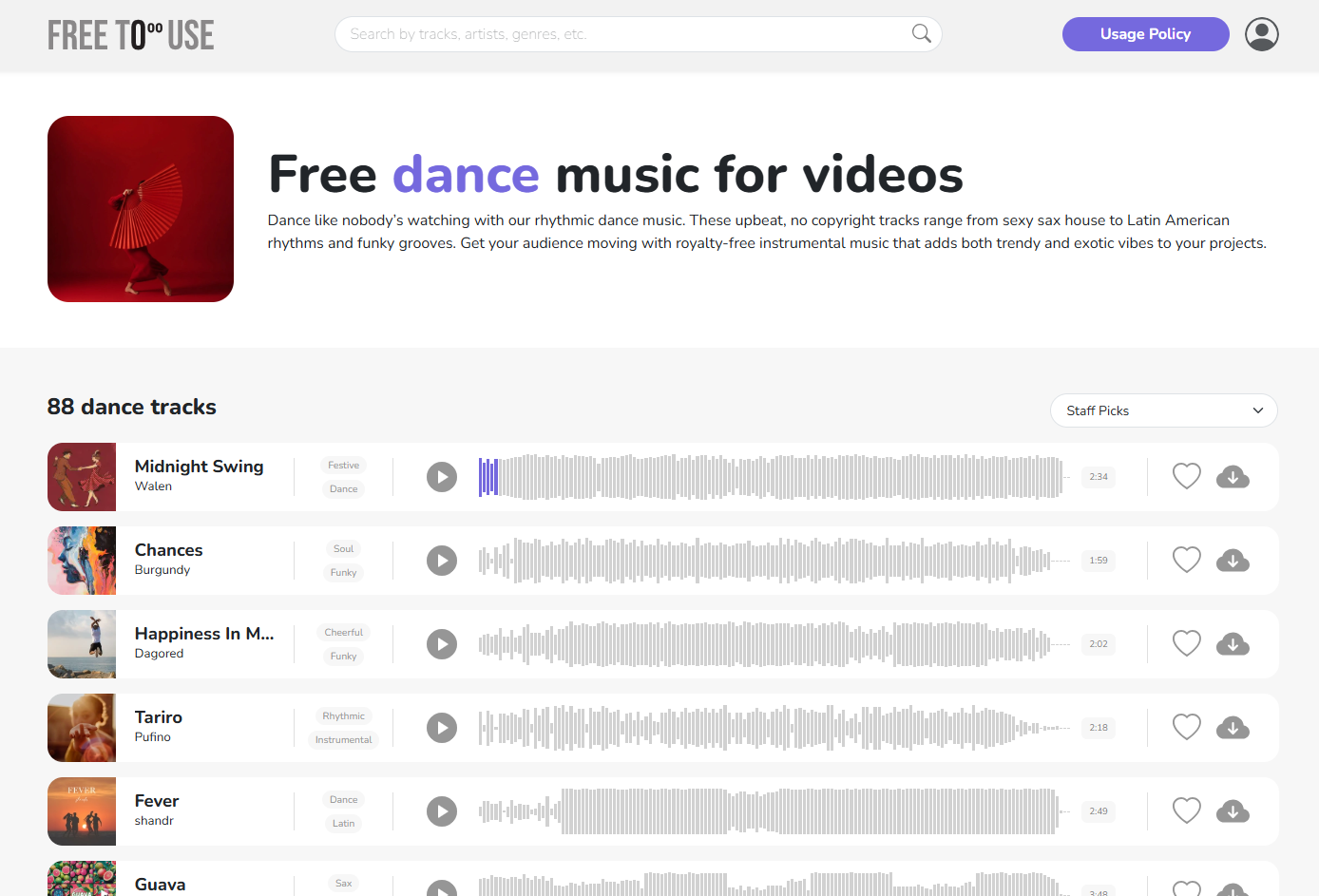
The library is arranged by mood and genre, and the organization is genuinely creator-friendly. You get the obvious buckets like cinematic, corporate, vlog, upbeat, ambient, lofi, electronic, hip-hop, and jazz, but there are also sharper mood categories like inspiring, emotional, energetic, relaxing, and epic. Seasonal tags such as christmas, halloween, and summer are available, and so are activity-based groupings like gaming, workout, travel, cooking, and sports.
What impressed me most is the consistent quality floor. This is not a bottomless pit of low-effort uploads. I listened to massobeats (their "gingersweet" is a lovely lofi piece), Pufino ("Eternity" delivers cinematic tension), Hazelwood ("At Ease" is exactly that), plus Aetheric, Johny Grimes, and Lukrembo. These are professional composers, and you can hear it.
The artist list spans more than 60 musicians. Aylex is the go-to for corporate and motivational energy, Zambolino brings the dramatic and epic scale, Moavii leans chill and tropical, and massobeats anchors the lo-fi corner. You will also find classical composers like Orchestronika and Aeris, electronic acts like Nebulite and Calima, and folk, rock, and world music throughout. Because one reviewer tags every track, the mood labels stay consistent, so "cinematic" means the same thing whether you are looking at an orchestral piece or an electronic one.
How the Two Ownership Models Compare
The music licensing world really splits into two architectural approaches, and which one a platform uses determines how safe your videos are.
Model One: The Hosting Directory
This is the model most free music sites use. The platform is essentially a venue. Independent producers upload tracks, mark them free or licensable, and keep the copyright for themselves.
The system works fine right up until it does not. Since the producer holds the rights, they can withdraw a track, rewrite the terms, or register it with Content ID and begin claiming every video that used it, including yours. The platform cannot intervene, because it never held the rights in the first place. You are left to fight the claim yourself, often with your video demonetized the whole time.
Model Two: The Owned Catalog
This is the model Free To Use uses, and it is dramatically safer. The platform purchases the full rights to every track directly from the artists. No hosting. No permission. Actual ownership.
The consequences of this model are significant. The music can be offered free forever because the platform is not dependent on a producer's goodwill. Terms remain stable. Tracks do not vanish. And when a false claim appears on a video, the platform resolves it directly, because the rights are theirs. You never have to chase a producer or fight a dispute alone.
This is the crux of the whole review: free tells you the price, but ownership tells you the risk. Free To Use's owned catalog makes the risk structurally low, which is what creators actually need.
Human Artists Only, No AI Shortcuts
Free To Use deliberately works only with human composers. Every track is written and performed by a real musician and reviewed by a person before it is published.
There is a legal reason this matters beyond simple quality. In most jurisdictions, purely AI-generated music cannot be copyrighted. That may sound like a good thing, but it actually creates a problem: if nobody owns a track, then nobody can verify it is original, stand behind it, or defend your use of it when a dispute arises. There is no one to clear the rights.
Human-made music, by contrast, can be owned and legally defended. For anyone needing copyright free music for youtube videos or no copyright music for tiktok videos, that legal backing is exactly what makes the difference between peace of mind and a potential claim.
Whitelisting and Real Claim Resolution
Here is something interesting: Free To Use actually has its catalog registered with YouTube's Content ID system and Meta's Rights Manager. At first glance that seems backwards for a platform that wants you to use its music freely. But it is actually the mechanism that makes the platform safe.
By being inside these systems, Free To Use can block unauthorized claims and correct false ones quickly. Paid subscribers can whitelist their YouTube channel, which tells YouTube the channel is authorized to use the catalog, and Content ID claims get stopped before they even surface. If one does slip through, you email the platform and they resolve it, usually within a few days.
Free users get essentially the same protection through a simpler path: add the required attribution, publish, and if a claim appears, email them the link. Because they own the rights, they handle it. This is something hosting-directory platforms simply cannot offer.
How the Business Stays Sustainable
If everything is free, how does the company make money? The answer is a sustainable freemium model. Free To Use ApS, based in Copenhagen, has operated this way since 2016.
The free tier with attribution drives visibility and adoption. Paid plans (Personal at €7.99/mo, Commercial at €18.99/mo, plus one-time licenses) serve creators who want to drop the attribution or use music in commercial contexts. Since the platform owns its catalog rather than paying per-stream royalties, the economics hold together. The model is designed to work at scale and has proven itself over the better part of a decade.
Using the Site: A Quick Walkthrough
I tested the platform the way a real creator would, hunting for an upbeat track for a product demo.
The homepage drops you straight into the music browser. No gatekeeping, no email capture, no "join our newsletter first." Just tracks, categories, and a search bar. I clicked "corporate," scrolled through, previewed a few, and settled on a track by Aylex.
Downloading pulled up a modal with the exact attribution text I needed:
Music from Free To Use
Source: https://freetouse.com/music
Track: [Track Name] by Aylex
I copied it, downloaded the MP3, and was done in under two minutes. No account, no email confirmation, no credit card, no download caps. If you produce multiple videos a week, skipping the login and limit management across platforms is a genuine time-saver.
Artist browsing also works well. Clicking massobeats surfaces their whole warm-lofi collection, while Zambolino spans orchestral drama to funky upbeat cuts. When you find a composer whose sound fits your brand, you can explore their entire body of work.
Pricing at a Glance
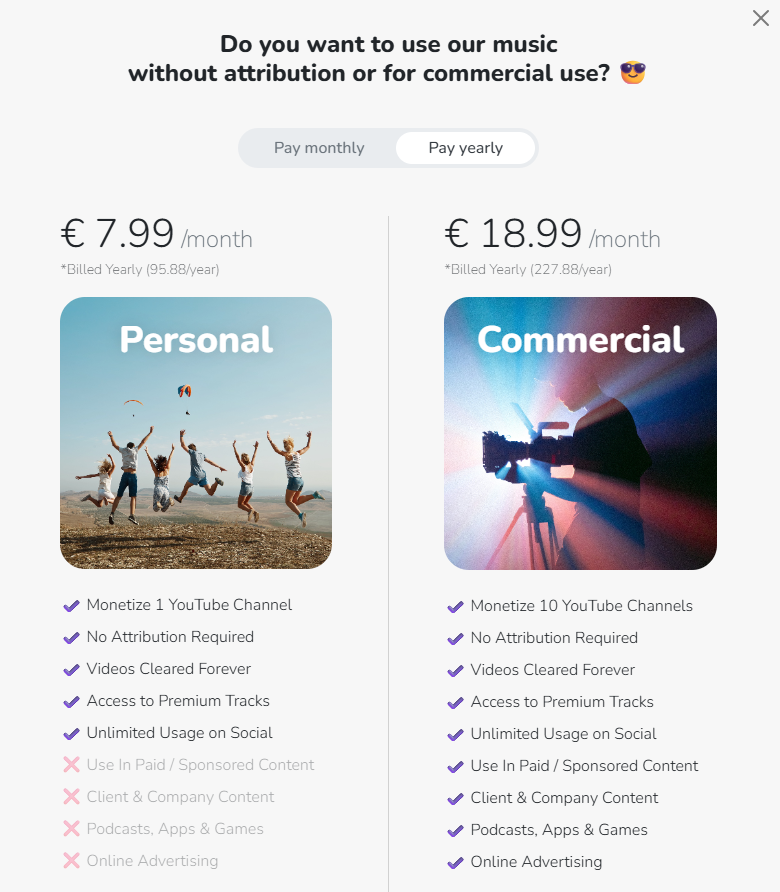
The pricing structure is refreshingly straightforward:
Free Plan — unlimited downloads, no account required, attribution required in the video description, monetization allowed. This is genuinely rare: unlimited free downloads with no sign-up, usable in monetized content, just with a credit line.
Personal Plan — €7.99/month annual or €11.99/month monthly. Drops the attribution requirement and lets you whitelist one YouTube channel to block Content ID claims. Worth it for frequent publishers who want a cleaner video description.
Commercial Plan — €18.99/month annual or €23.99/month monthly. Removes attribution and whitelists up to 10 channels. Built for agencies, marketers, businesses, and freelancers doing client work.
Pro License — €50 one-time for a single track. Unlimited commercial use plus one digital product, with one channel permanently whitelisted. Good for a signature campaign track.
Broadcast License — €450 one-time for a single track. Everything in Pro plus TV, film, radio, and large-scale advertising. On par with or cheaper than most production libraries.
One important guarantee: any content published while your subscription is active stays cleared forever, even if you cancel. Your back catalog remains safe; only new videos after cancellation need fresh coverage.
Who Benefits Most
YouTubers and long-form creators need copyright free music for youtube videos that stays safe for years, since evergreen videos keep earning long after publishing. Owned-catalog safety is the strongest argument here.
TikTok and Instagram creators need no copyright music for tiktok videos that is quick to grab and safe to monetize. The no-account workflow is perfect for fast mobile-first publishing.
Twitch streamers need background music that will not trigger muted VODs. Free To Use covers streaming in its license, and its own Content ID presence reduces the chance of automated muting.
Podcasters need reliable intro/outro tracks. The free plan covers this with attribution, and the Commercial plan whitelists up to 10 channels for networks.
Video editors and freelancers constantly juggle music licensing for clients. The Commercial plan's unlimited commercial use for 10 accounts costs a fraction of per-project stock licenses.
Businesses and marketing teams producing brand content get licensing clarity without per-video fees, plus a privacy-first experience with no tracking while sourcing music.
Educators and course creators benefit from the instrumental focus that sits well under narration, with the free tier handling most educational use cases.
What Sets Free To Use Apart
- Complete catalog ownership — nobody can pull tracks or file claims.
- Zero AI music — every track is human-made and defensible.
- Direct claim resolution — the platform handles disputes because it owns the rights.
- No account required — browse, listen, and download instantly.
- Consistent curation — a single reviewer keeps tags meaningful across the catalog.
- Privacy-first — no cookies, no tracking, no data collection.
- Post-cancel coverage — published content stays cleared forever.
Competitive Comparison
| Feature | Free To Use | Upload-Based Platforms | AI-Mixed Platforms |
|---|---|---|---|
| Catalog Ownership | ✅ Platform owns 100% | ❌ Individual producers | ❌ Often unclear |
| Human Artists Only | ✅ Yes | ✅ Mostly | ❌ Mixed with AI |
| Claim Resolution | ✅ Direct by platform | ❌ You are on your own | ❌ Legally uncertain |
| No Sign-Up Required | ✅ Yes | ❌ Usually required | ❌ Usually required |
| Unlimited Free Downloads | ✅ Yes | ❌ Often capped | ❌ Often capped |
| Consistent Curation | ✅ Single reviewer | ❌ Uploader-tagged | ❌ Automated tagging |
| Privacy Protection | ✅ No tracking | ❌ Tracked heavily | ❌ Tracked heavily |
| Post-Cancel Coverage | ✅ Published safe | ❌ Often revoked | ❌ Often unclear |
Five Checks for Any Royalty-Free Library
- Who owns the catalog? If the platform hosts uploads rather than owning them, a producer can claim your video later. Prefer platforms that own their music outright.
- What happens on a claim? Owned-catalog platforms can resolve claims directly. Hosting directories usually cannot, leaving you to fight alone.
- Is the music human-made? AI music often cannot be copyrighted, meaning nobody can defend your use. Human-made tracks are legally defensible.
- Are terms clear and stable? Confirm the license covers monetization across YouTube, TikTok, Instagram, Twitch, and podcasts, with no regional limits and protection for older videos.
- Is attribution required? A short credit line is a fair trade, but know it upfront. Free To Use displays the exact text with every download.
If a library cannot tell you who owns its music, treat that as a red flag. Free tells you the price. Ownership tells you the risk.
Final Verdict
Free To Use delivers on the promise that most royalty-free music sites cannot keep: because they own every track, they can actually protect you when a claim appears. A platform that merely hosts uploads cannot make that guarantee.
The free tier is exceptional — unlimited downloads, no sign-up, monetization allowed with a credit line. For creators building a back catalog of evergreen content, the long-term safety of an owned catalog is worth far more than sheer track count. Paid plans are fairly priced, and the whitelist and claim-resolution features provide genuine peace of mind for frequent publishers.
The main limitation is catalog size and the instrumental focus; vocal tracks and niche genres are thinner. But for the core use case of safe, human-made background music, Free To Use is one of the safest options available.
Review Summary
- Music Quality: ⭐⭐⭐⭐⭐ (5/5)
- Copyright Safety: ⭐⭐⭐⭐⭐ (5/5)
- Licensing Simplicity: ⭐⭐⭐⭐⭐ (5/5)
- Value for Money: ⭐⭐⭐⭐⭐ (5/5)
- Catalog Variety: ⭐⭐⭐⭐ (4/5)
- Platform Usability: ⭐⭐⭐⭐⭐ (5/5)
- Overall Review Score: ⭐⭐⭐⭐½ (4.8/5)
Grab some safe background music for your next video 👉 Visit Free To Use — no sign-up required.
Tags
# Review# Free To Use# royalty-free music# no copyright music# copyright free music# free to use music# free music download# copyright free music for youtube videos# no copyright music for tiktok videos# free background music# safe music for content creators# royalty free music for youtube# music without copyright claims# free music for video editing# royalty-free tracks# content creator music# youtube safe music# tiktok safe music# streaming background music# podcast background musicCashwerk Review - All-in-One Workflow Platform for Business Efficiency
LicenseGen Review - License Key Manager for Software
Follow for new blogs
Subscribe to our blog
Subscribe to Newsletter
Subscribe to our newsletter to get the best products weekly.